
Electrical Panel
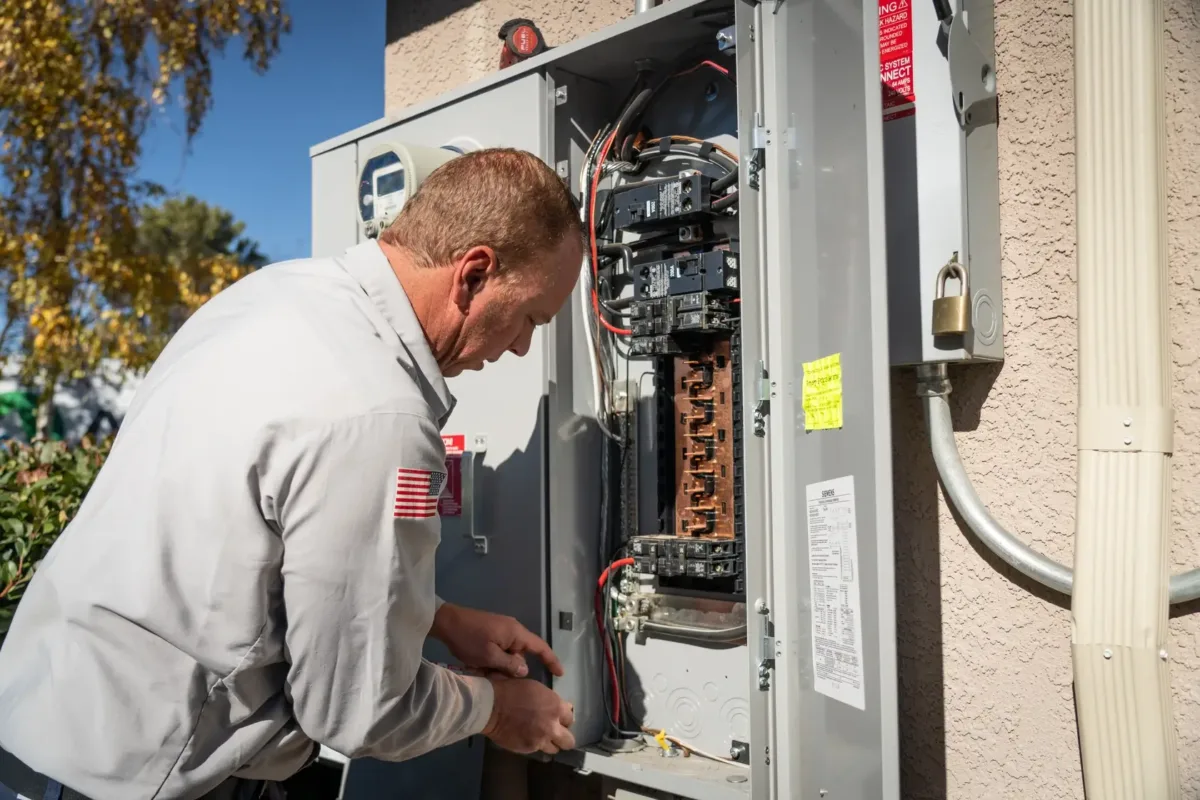
An electrical panel is the central hub that receives power from your utility and distributes it to every circuit in your home. It controls which circuits get power, protects your wiring from overloads, and is the first place you go when something stops working.
Most homes in Arizona run on a 200-amp panel. If yours is older or you have added major appliances, EV chargers, or a hot tub, your panel may be undersized for today’s load. Knowing how it works helps you spot problems early and make smarter decisions.
Key Takeaways
- Your electrical panel controls the power flow to every room in your home.
- Each circuit breaker is sized to the wiring it protects, usually 15 or 20 amps.
- The 120 rule limits the number of breakers you can safely add to a panel.
- Most homes today need at least a 200-amp panel to run modern appliances.
- Signs like frequent tripping, warm panels, or flickering lights mean it is time for an inspection.
What Is an Electrical Panel and What Does It Do?
Your electrical panel (also called a breaker box or load center) sits between the utility line coming into your home and the circuits inside your walls. It accepts the incoming power, splits it across individual circuits, and protects each one with a breaker.
When a circuit draws more current than its breaker allows, the breaker trips. That is not a flaw. That is the breaker doing exactly what it should: stopping the current before the wiring overheats.
If your panel trips frequently, it is a sign that the circuit is overloaded or that there’s a fault somewhere. You can read more about that in our post on circuit breaker causes.
The Main Parts of an Electrical Panel
Every residential panel has the same core components. Here is what each one does:
- Main breaker: Controls all power entering the panel. Flip this to cut power to the whole house during emergencies or major electrical work.
- Bus bars: Metal bars that carry current from the main breaker to each individual circuit breaker.
- Circuit breakers: Each one controls one circuit. They are sized by amperage: 15A for lighting and general outlets, 20A for kitchens and bathrooms, and 30 to 60A for large appliances.
- Neutral bar: The return path for the current. Each circuit’s neutral wire connects here to complete the loop.
- Ground bar: A Safety connection that routes fault current into the earth instead of through a person.
If any part of this system is damaged or outdated, the whole panel is at risk. That is why electrical panel inspections matter, especially in homes that are 20 years or older.
How Does an Electrical Panel Work, Step by Step?
Here is the flow of electricity from the utility to your outlets:
- Power arrives at your home through two hot service wires, each carrying 120 volts. Together, they supply 240 volts.
- Those wires connect to the main breaker at the top of the panel.
- From the main breaker, power flows onto two bus bars, one for each 120V leg.
- Individual breakers snap onto alternating bus bars. Single-pole breakers (120V) use one bar. Double-pole breakers (240V) span both bars.
- Each breaker feeds one circuit through a hot wire running through your walls.
- Current returns to the panel on the neutral wire and exits to the utility through the neutral service line.
The whole process takes milliseconds. When a breaker senses too much current, a thermal or magnetic mechanism trips the breaker, opening the switch and causing the circuit to go dead within fractions of a second.
Common Breaker Sizes and Their Uses
| 15A | Lighting, bedroom outlets | 120V (single-pole) |
| 20A | Kitchen, bathroom, laundry outlets | 120V (single-pole) |
| 30A | Electric dryer, water heater | 240V (double-pole) |
| 40A | Electric range, EV charger | 240V (double-pole) |
| 50A | Hot tub, large HVAC | 240V (double-pole) |
| 60A+ | Sub-panels, large AC units | 240V (double-pole) |
What are L1, L2, and L3 in Electrical?
L1 and L2 are the two 120V hot legs in a standard residential electrical panel. Together, they supply 240V for large appliances. L3 is a third phase found in three-phase commercial or industrial panels, not in typical homes.
In your breaker box, single-pole breakers draw from either L1 or L2. Double-pole breakers draw from both. That is why your dryer or air conditioner uses a larger, double-wide breaker: it needs both legs to operate at full voltage.
What Are the Four Types of Electrical Panels?
Not every home has the same type of panel. Here are the four most common:
- Main breaker panel: The most common type. The main breaker controls all power to the panel and protects against whole-house overloads.
- Main lug panel: Has no main breaker. Power feeds directly to the lugs (terminals). These are used as sub-panels fed from a main panel elsewhere.
- Sub-panel: A secondary panel fed from the main panel. Common in garages, shops, or additions where running individual circuits from the main panel would be too long.
- Transfer switch panel: Used with generators. It lets you switch between utility power and generator power safely without backfeeding the grid.
If you are adding a shop, garage, or large addition, a sub-panel is often the most practical solution. Learn more about electrical panel installation options for your home.
What Is the 120 Rule for Electrical Panels?
The 120 rule is a National Electrical Code (NEC) guideline for determining how many breakers you can safely add to a panel. It works like this: add up the amperage of all breakers in the panel. That total cannot exceed 120% of the panel’s main breaker rating.
Example: A 200-amp panel can carry up to 240 amps of breaker capacity (200 x 1.2 = 240). If your existing breakers total 230 amps and you want to add a 30-amp circuit for an EV charger, you are over the limit. You would need a panel upgrade or a sub-panel.
If you are considering adding an EV charger, HVAC system, or another high-draw circuit, run this calculation first. Assurance Electrical can review your panel load and tell you exactly what you can add. See our panel upgrade service for more.
What Is an HT and LT Panel?
HT (High Tension) and LT (Low Tension) panels are commercial and industrial terms. An HT panel operates at voltages above 1,000 volts and is used by utilities or large industrial facilities. An LT panel operates below 1,000 volts and is what most commercial buildings use.
As a homeowner, you will never deal with an HT panel. Your residential panel is an LT system, typically rated at 120/240 volts. The distinction matters if you are expanding into commercial property or working with an industrial electrician.
Things to Know About Your Electrical Panel
- Panels have a lifespan. Most residential panels last 25 to 40 years. If yours is older than that, it is worth having an electrician evaluate it, even if nothing has tripped.
- Breakers can wear out. A breaker that trips repeatedly may be faulty, not just overloaded. Replacing a single breaker is inexpensive. Ignoring it is not.
- Federal Pacific and Zinsco panels are known safety hazards. If you have one, schedule a replacement. These brands have documented histories of failing to trip during overloads.
- Labeling every breaker saves time in emergencies. If your panel is unlabeled, spend 30 minutes mapping circuits and labeling them clearly.
- A warm or buzzing panel is not normal. Both are signs of a loose connection or overloaded circuit. Call an electrician before it becomes a fire hazard.
Not sure about the condition of your panel? Our residential electrical services include full panel inspections. We can tell you if your panel is safe, sized correctly, and code-compliant.
Your Panel, Checked by Your Neighbor’s Electrician
Understanding how an electrical panel works puts you ahead of most homeowners. You know what each part does, why breakers trip, how to read your load capacity, and when to call a professional.
If your panel is aging, frequently tripping, warm to the touch, or simply unlabeled, that is your signal. A quick inspection costs far less than a panel failure or fire.
Assurance Electrical Services is your local electrician in Arizona. We serve Prescott, Prescott Valley, Chino Valley, and the surrounding areas. Call us or schedule a home safety inspection to see exactly what your panel needs.
Frequently Asked Questions
How does an electrical panel work?
It receives power from your utility, routes it through a main breaker, distributes it across bus bars, and delivers it to individual circuits through circuit breakers that shut off automatically if too much current flows.
What is L1, L2, and L3 electrical?
L1 and L2 are the two 120V hot legs in a residential panel. Together, they power 240V appliances. L3 is a third phase used only in commercial and industrial three-phase systems.
What is an HT and LT panel?
HT (High Tension) panels operate above 1,000 volts in industrial or utility settings. LT (Low Tension) panels operate below 1,000 volts. Your home panel is an LT system at 120/240 volts.
What are the four types of electrical panels?
The four types are main breaker panels, main lug panels, sub-panels, and transfer switch panels. Most homes use a main breaker panel as the primary distribution point.
What is the 120 rule for electrical panels?
The 120 rule (NEC 408.54) says the total amperage of all breakers in a panel cannot exceed 120% of the panel’s main breaker rating. For a 200-amp panel, the maximum is 240 amps across all breakers.