
Electrical Panel
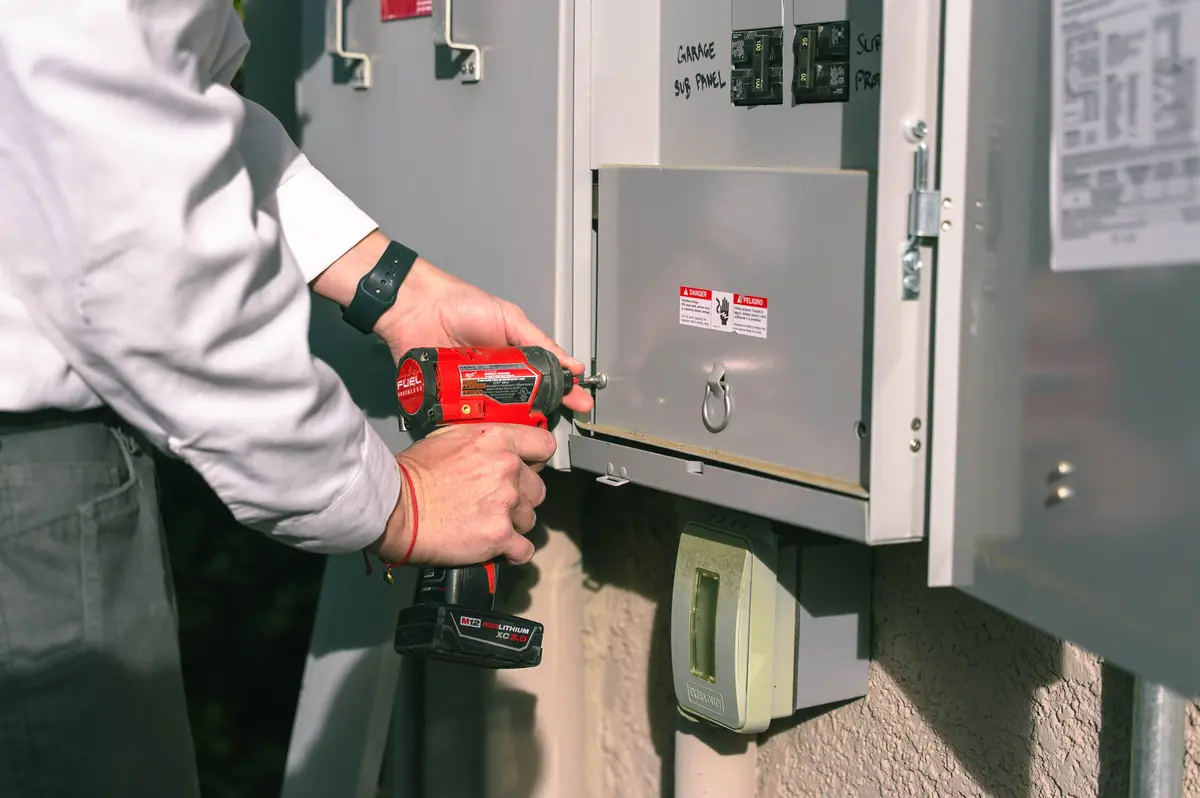
To read electrical panel labels, open the panel door and find the index card or directory inside. Match each number on the list to the corresponding breaker switch in the left or right column. Each label identifies what the breaker controls (such as a specific room, appliance, or area), its amperage rating (the amount of electrical current it can safely handle, such as 15, 20, 30, or 50 amps), and whether it is single-pole (controls one circuit) or double-pole (controls two circuits for higher voltage appliances).
When a breaker trips, a circuit goes dead, or a new appliance needs a dedicated line, knowing how to read what is in front of you saves time, prevents mistakes, and helps you communicate clearly with your electrician. If your panel is already showing performance issues, see the electrical troubleshooting guide before reading further.
Key Takeaways
- The directory inside the panel door lists each circuit by number. If missing, mapping and labeling take about 30 minutes.
- The number on a breaker switch is its amperage rating, not its circuit number; these are separate details.
- A single-pole breaker controls one 120-volt circuit. (A volt is a unit that measures electrical force or potential.) A double-pole breaker controls one 240-volt circuit, meaning it supplies more power and takes up two slots in the panel.
- A breaker positioned between ON and OFF is tripped. Push it fully OFF, then back ON to reset.
- If a breaker trips again after resetting, something on that circuit is overloading it. Do not keep resetting.
- Labels on older Prescott homes are often wrong, incomplete, or outdated due to past changes.
What You See When You Open the Panel Door
The Directory. The directory is a paper or cardstock label inside the panel door. It has two columns of numbered lines, one for each row of breakers. Each line should have a written description: “Kitchen outlets,” “Master bedroom,” “Dryer,” “HVAC,” and so on. If it is blank or missing, the mapping section below tells you how to complete it.
The Main Breaker.
The main breaker sits at the top or bottom of the panel, set apart from the individual circuit breakers. The amperage rating is printed directly on it: 100, 150, or 200 amps are the most common values in Prescott-area homes. Flipping it OFF cuts power to every circuit in the house. It does not cut power from the utility side. The wires feeding into the main breaker remain live even when the main is off. Our post on main service panel inspections covers what a professional checks around the main breaker.
Individual Circuit Breakers.
The rows of smaller switches below the main breaker are your circuit breakers, organized in two columns. Each switch has a number on its face. That number is its amperage rating, not a circuit identification number. The circuit ID is in the directory. 15-amp breakers cover lighting and general outlets. 20-amp breakers cover kitchens, bathrooms, and higher-demand circuits. 30-amp or 50-amp double-pole breakers serve large appliances such as dryers, ranges, and HVAC units.
Empty Slots.
Blank slots represent circuits that can be added without replacing the panel. If your panel has no empty slots and you need to add a circuit, you need either a tandem breaker or a panel upgrade. Our post on electrical panel sizes covers what your current panel can handle.
Every Label and Marking Explained
Amperage Ratings
| Amperage | Breaker Type | Typical Use |
| 15A | Single-pole (120V) | Bedroom outlets, hallway lights, and living room circuits |
| 20A | Single-pole (120V) | Kitchen outlets, bathroom outlets, garage outlets, laundry |
| 30A | Double-pole (240V) | Electric dryer, water heater, window AC units |
| 40A | Double-pole (240V) | Electric range, oven |
| 50A | Double-pole (240V) | EV charger, hot tub, large HVAC circuits |
| 60A+ | Double-pole (240V) | Sub-panel feeder, large workshop circuits |
Single-Pole vs. Double-Pole Breakers
A single-pole breaker occupies one slot and controls a 120-volt circuit (the standard voltage for most outlets and light fixtures; a volt is a unit of electric potential). A double-pole breaker occupies two slots and controls a 240-volt circuit (providing double the voltage). It has two switches joined by a single handle, so both sides trip together. Any appliance requiring 240 volts, such as dryers, ranges, and EV chargers, needs a double-pole breaker. In the directory, a double-pole breaker takes up two slot numbers even though it is one circuit.
AFCI and GFCI Labels
Some breakers have extra text: AFCI (Arc-Fault Circuit Interrupter) or GFCI (Ground-Fault Circuit Interrupter). AFCI breakers detect dangerous electrical arcs (unintended electricity jumping between conductors) and are required by Arizona code in bedrooms and living areas. GFCI breakers protect against ground faults (electrical current flowing along an unintended path, which can cause shocks) and are required in bathrooms, kitchens, garages, and outdoor circuits. Both types have a test button on the breaker itself. See how GFCI outlet installation compares to breaker-level GFCI protection.
The Tripped Position
A tripped breaker sits between ON and OFF, slightly toward the center of the panel. To reset it: push it fully to OFF first (you will feel a click), then push it back to ON. If it trips again within seconds, something on that circuit is still drawing too much current. Unplug or turn off devices on that circuit before resetting. If it trips with nothing connected, the breaker itself may be failing. See what causes circuit breakers to trip for the full explanation.
I and O Symbols
I means ON (power flowing) and O means OFF (power cut). These are the international standard symbols used on electrical equipment. If a switch sits between I and O and does not click into either position, the breaker is tripped. Push it firmly to O first, then back to I. If it will not stay in the I position, the circuit has a fault. See circuit breaker repair if yours is not resetting correctly.
How to Map and Label an Unlabeled Panel
You can map every circuit in about 30 minutes with a partner or a plug-in circuit tester.
Turn all breakers ON except one. Start with the top-left breaker in the left column. Walk through the house and test every outlet, light switch, and hardwired fixture. Note which ones have no power. Write a specific description next to that breaker number: “Kitchen counter outlets east wall” beats “Kitchen.” Turn that breaker back ON, then turn the next one OFF. Repeat for every breaker.
For double-pole breakers (dryer, range, HVAC), both slots go dead when you flip one off. Label both slot numbers with the same description and note “240V double-pole.”
Once done, write the final directory in permanent marker or photograph it on your phone.
In older Prescott homes, previous owners often added circuits without updating the directory. Treat any pre-existing directory as a starting point for verification. A professional electrical inspection includes circuit mapping and catches wiring problems that a directory check alone will not find.
Panel Safety Rules and Things to Know
Keep the panel door closed when you are not actively working on it. The internal bus bars are energized even when the main breaker is off. Arizona code requires a minimum of 36 inches of clear space in front of the panel at all times.
Never tape a tripped breaker into the ON position. A breaker that keeps tripping signals a problem. See what causes circuit breakers to trip rather than forcing them to stay on.
Do not open the inner panel cover behind the breakers. That exposes the bus bars and live wiring. Only a licensed electrician works behind that cover.
If you smell burning, hear buzzing or crackling, or see scorch marks, shut off the main breaker and call for emergency electrical service immediately. If your panel is warm to the touch, see electrical panel overheating for what that indicates.
A 20-amp breaker does not mean you can run 20 amps continuously. NEC code caps sustained load at 80 percent of rated capacity, so a 20-amp circuit should carry no more than 16 amps continuously.
If multiple outlets stop working and no breaker appears tripped, look for a GFCI outlet in that area. One GFCI can protect several downstream outlets. Its reset button may be in a bathroom, garage, or kitchen you have not checked. See multiple outlets not working for the troubleshooting steps.
If your panel has no empty slots and you need to add a circuit, you need either a tandem breaker or a panel upgrade.
Schedule a Panel Inspection or Labeling Visit
If your panel is unlabeled, outdated, or showing any warning signs, Assurance Electrical serves Prescott, Prescott Valley, Chino Valley, and the Quad Cities area. Contact us today to schedule an inspection. We will walk through your panel, label it correctly, and give you a straight answer on what it needs.
Frequently Asked Questions
How do you read an electrical panel?
Open the panel door, check the directory inside for circuit descriptions, match each number to its corresponding breaker switch, and read the amperage rating on each breaker’s face. If the directory is blank, the mapping process above lets you complete it in about 30 minutes. If anything looks unfamiliar or concerning, a residential electrical inspection is the right next step.
How are electrical panels labeled?
Panels are labeled using a directory card inside the door that matches circuit numbers to room names or appliances. Amperage ratings are printed directly on each breaker face. In practice, many directories are incomplete or outdated, especially in homes that have changed hands or been renovated. See the electrical inspection checklist for what a licensed electrician reviews during a full panel assessment.
What is an HT and LT panel?
HT (High Tension) panels operate at voltages above 1,000 volts, and are used at utility substations and large industrial facilities. LT (Low Tension) panels operate at voltages below 1,000 volts and are used in residential systems. Your home panel is an LT system operating at 120/240 volts. You will never encounter an HT panel in a home.
What are L1, L2, and L3 in electrical?
L1 and L2 are the two hot legs, meaning wires carrying electrical current in a residential 240-volt system, each carrying 120 volts with respect to neutral. Single-pole breakers connect to either L1 or L2. Double-pole breakers connect to both, delivering 240 volts to appliances like a dryer, range, or EV charger. L3 refers to a third current-carrying wire in commercial three-phase power systems, not used in standard home wiring.