
Electrical Panel, Electrical Safety, Electrical Tips
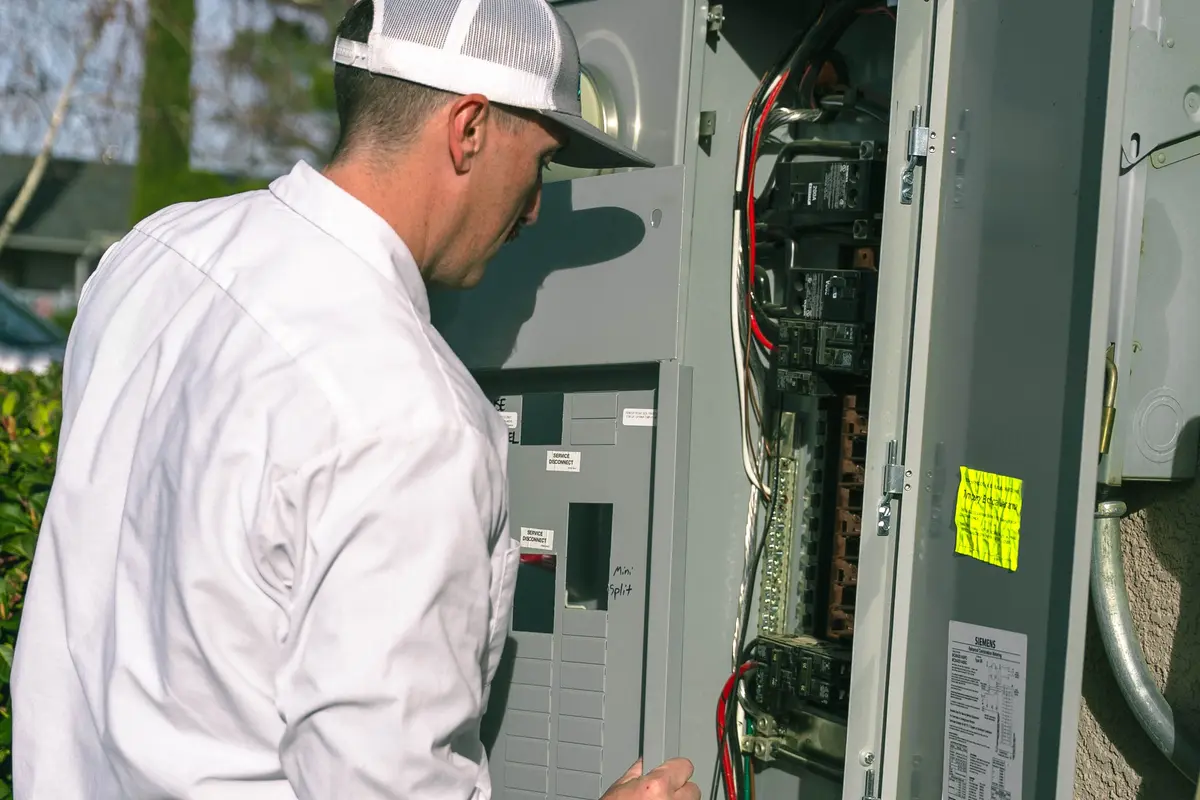
An electrical panel board, also known as a breaker box, is a metal box that receives electricity from the utility company and distributes it to each circuit in your home through individual circuit breakers (devices that automatically interrupt the flow of electricity if a problem is detected). It serves as the main safety device: it automatically disconnects power to any circuit that becomes overloaded (has too much electrical demand), short-circuits (when the electrical current takes an unintended path), or develops a ground fault (when the current flows to the ground unintentionally), which prevents the wiring from overheating.
Key Takeaways
- Your electrical panel board receives power from the utility and routes it to every room and appliance through individual circuit breakers.
- Circuit breakers trip automatically when a circuit draws too much current, stopping heat buildup before it causes a fire.
- The four main residential panel types are: main breaker panel, main lug panel, sub-panel, and fuse box.
- Most modern homes need at least 200-amp service; homes with 60 or 100-amp panels may be underpowered for today’s loads.
- Panels over 25 years old or from known problem brands should be inspected by a licensed electrician, regardless of how they look on the outside.
How an electrical panel board actually works within your home.
Electricity arrives from the utility through thick service entrance wires that bring power into your home. It passes through your electric meter, which records your usage, and then enters the panel. Inside the panel, the electricity is split into individual branches, called circuits. Each circuit is controlled by a circuit breaker, a switch that automatically turns off if too much current flows. The panel does two jobs: it distributes power to every outlet, light, and appliance in your home, and it protects each circuit from carrying more electricity than the wires can safely handle.
Two hot wires enter the panel, each carrying 120 volts, for a total of 240 volts. They connect to the main breaker, typically rated at 100, 150, or 200 amps. Power then flows into two metal bus bars. Circuit breakers clip onto these bars: single-pole breakers supply 120V to outlets and lights; double-pole breakers deliver 240V to large appliances like dryers, ranges, and HVAC units.
When a circuit draws more electrical current than the breaker’s rated amperage (the amount it can safely carry), the breaker “trips” or shuts off automatically. You reset it manually after removing whatever caused the overload. The flow of electricity returns to the panel through the neutral bar, which connects back to the utility and completes the circuit. Our post on what causes circuit breakers to trip covers the most common reasons breakers trip.
Panel Components and What Each One Does
| Component | What It Does | Why It Matters to You |
| Main breaker | Single switch controlling all incoming power; rated 100A, 150A, or 200A | First shutoff during any electrical emergency or panel work |
| Bus bars | Copper or aluminum conductors carrying power to each circuit breaker | Distribute load evenly; must stay insulated to prevent arcing |
| Circuit breakers | Trip automatically when a circuit exceeds its rated limit | Stop heat buildup before wiring overheats |
| Neutral bar | Return path for current back toward the utility transformer | Completes every circuit safely |
| Ground bar | Connects all ground wires and directs fault current into the earth | Protects people from shock |
| Enclosure | Metal cabinet housing all live components | Keeps live wires inaccessible; rated for fire resistance |
| Circuit labels | Directory identifying which breaker controls each room or appliance | Speeds up troubleshooting; ensures correct shutoff during repairs |
The circuit label directory inside the panel door is critical. This directory is a chart or list that identifies which breaker, or switch, controls each area or appliance in your home. Inaccurate labels leave you guessing which circuit to shut off during repairs or emergencies. A licensed electrician can map and label circuits during an inspection.
The Four Types of Electrical Panel Boards
1. Main Breaker Panel
The most common modern home panel. A large main breaker at the top controls all power; two rows of circuit breakers fill the panel below. Typical sizes are 100, 150, and 200 amps. Homes with EV chargers, central air, electric dryers, or additions usually need at least 200-amp service. See our post on panel sizes for matching capacity to load.
2. Main Lug Panel
The main lug panel lacks a main breaker. The incoming wires connect directly to lugs inside, and the disconnect is upstream at the meter base or an external switch. Main lug panels are secondary devices, with the main disconnect already at the meter.
3. Sub-Panel
A sub-panel is a smaller electrical panel that receives power from the main panel and distributes it to a specific area, such as a garage, workshop, or addition. The main panel supplies the sub-panel via a dedicated double-pole breaker, a switch that can disconnect both live wires, and its size matches the expected electrical load. Our post on installation covers the planning process.
4. Fuse Box
Fuse boxes are found in homes built before the 1960s. Instead of resettable breakers, they use fuses that physically melt when a circuit overloads. These panels are typically rated for 60 to 100 amps, well below what most modern homes require. They also lack GFCI and AFCI protection, and many were modified by previous owners with oversized fuses that allow wiring to carry more current than it can safely handle. Many insurance companies now require the replacement of the fuse box as a condition for issuing or renewing a homeowner’s policy. Our post on why fuses blow explains the common causes, and if you are wondering whether a homeowner can replace an electrical panel, it addresses that directly.
Signs Your Electrical Panel Board Needs Professional Attention
- Breakers that trip repeatedly on the same circuit without a clear overload source
- A breaker that will not reset, or trips again immediately after resetting
- A burning smell, a warm panel cover, or visible scorch marks around any breaker slot
- Buzzing, crackling, or humming sounds from inside the enclosure
- Rust, corrosion, or moisture inside or around the panel
- Panel is over 25 years old, or is a known problem brand such as Federal Pacific, Zinsco, or Pushmatic.
- Your home runs on 60- or 100-amp service, but you have added an EV charger, a second HVAC unit, or significant new appliances.
A burning smell or warm panel cover requires immediate attention. Our post on electrical panel overheating explains the causes and what to do about them. For a complete assessment, our guide on main service panel inspections covers exactly what a licensed electrician checks.
Things to Know About Your Home’s Electrical Panel
The 80 percent rule applies to continuous loads: any circuit used for 3 or more hours should not exceed 80 percent of the breaker’s rating. A 20-amp breaker should not carry more than 16 amps continuously.
Panel size is measured in amps, which indicates the maximum electrical current the panel can safely handle. It does not refer to the physical size. For example, a 200-amp panel and a 100-amp panel can look almost the same from the outside. What matters is the number on the main breaker, which tells you the amp rating.
Empty breaker slots are valuable. Spare slots let you add circuits later without replacing the entire panel.
Panel work requires a permit in Arizona. Any panel replacement, upgrade, or change in service capacity requires a permit. Our post on upgrading an electrical panel walks through the permit process. If someone offers panel work without a permit, walk away.
If you are buying a home, ask about the panel’s age, brand, and amperage before closing. Some lenders flag known problem brands as a condition of financing. The cost of a residential electrical inspection in Arizona is a small investment compared to the cost of discovering panel problems after closing.
Schedule a Panel Inspection or Upgrade
Assurance Electrical Services serves Prescott, Prescott Valley, Chino Valley, and the Quad City area. We inspect, replace, and upgrade residential electrical panels. If your panel is aging, showing warning signs, or undersized for your home’s needs, we can assess it and give you a clear picture of what is needed and what it will cost. Contact us today for a free quote or to schedule a panel inspection.
Frequently Asked Questions
What is a panel board in electrical?
A panel board is the metal enclosure that receives power from the utility and routes it to every circuit through circuit breakers or fuses. Every outlet, light, and appliance in your home gets its power through a circuit originating at this panel. It is also where you cut power to a specific area for repairs or in an emergency.
What is the difference between a breaker box and a panel board?
Nothing. They refer to the same device. Breaker box is the informal term most homeowners use; panel board is the formal industry term. Load center, distribution board, and service panel are also used interchangeably.
What are the four types of electrical panels?
Main breaker panel, main lug panel, sub-panel, and fuse box. The main breaker panel is the standard type in modern homes. The main lug panel has no integrated disconnect and serves as a secondary panel. A sub-panel serves a defined area fed from the main panel. A fuse box uses replaceable fuses instead of resettable breakers, which are most common in homes built before the 1960s, and poses both safety and capacity problems in most modern households.
What is an HT and LT panel?
HT (high-tension) panels handle high-voltage utility power. LT (low-tension) panels distribute standard voltage within a building. Your home’s breaker box is an LT panel, operating at 120V and 240V. HT equipment is entirely the utility’s responsibility.
What is a PCC and MCC panel?
A PCC (Power Control Center) manages high-capacity power in industrial facilities. An MCC (Motor Control Center) controls industrial electric motors. Neither applies to residential electrical systems. For home electrical needs, including common electrical upgrades, fixing a circuit breaker that keeps tripping, or home wiring safety checks, the residential main breaker panel applies.